


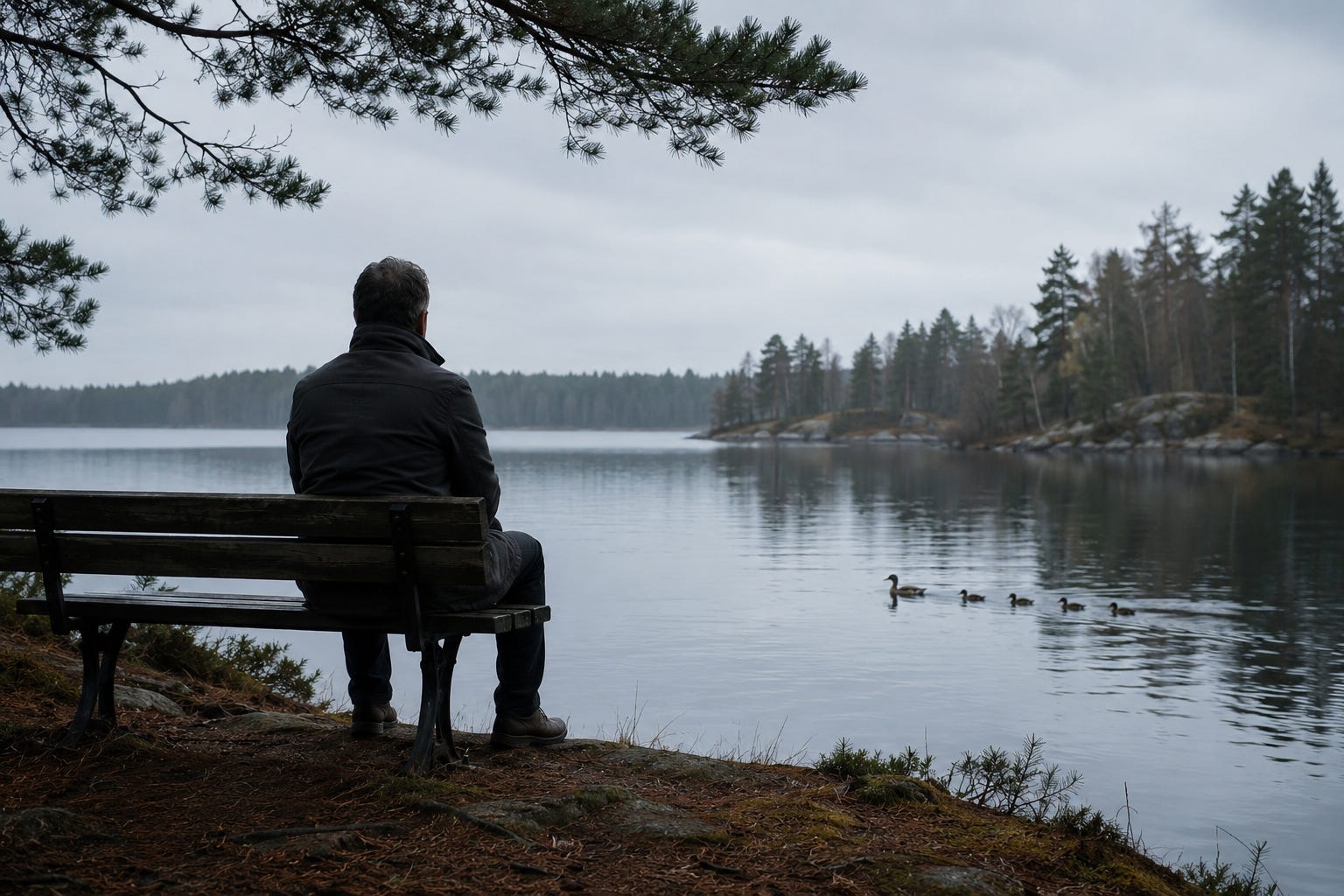
I wonder if we’re too quick to treat discomfort as evidence that something needs to change.
Like a relationship feels off.
Work feels heavier than it used to.
A question that keeps showing up in the back of our minds.
We notice a gap between where we are and where we’d like to be, and almost immediately start looking for ways to close it.
Part of me has always treated those gaps as problems to solve.
That if a gap exists, surely the goal is to eliminate it, right?
But recently, I’ve found myself wondering if that’s always true.
Because not every gap is the same.
Some are warnings.
Others are invitations.
And some seem less interested in being solved than in being understood.
I was in a strange in-between state for many years after stepping down as CEO of the company I founded.
Whenever someone asked what I wanted to do next, I could tell them why I wanted to leave.
But I never knew how to answer the second half of the question.
The conversation would usually stall there.
I remember occasionally scrolling through job listings, even though I had no intention of applying. Not because I expected to apply, but because I had difficulty imagining what else existed.
But every option felt like a variation of the life I was trying to leave behind.
I didn’t know what I wanted to do next. I only knew that the life I was living no longer felt like mine.
For a long time, I remember treating that uncertainty as a problem.
I thought the discomfort existed because I hadn’t figured out the answer yet.
What should I do next?
What career would replace this one?
What is the plan?
I remember asking different coaches and mentors those questions. Most of them came back with some version of the same advice: figure out what you’re passionate about, imagine your ideal future, start moving toward it.
I usually left those conversations feeling more frustrated than before.
It took me a while to understand why. The advice wasn’t bad. It was just answering a different question than the one I had. Everyone assumed the gap was a problem of not knowing the answer, so they handed me ways to find one.
The solution everybody reached for first was the wrong one. Not because they were careless, but because the gap wasn’t asking for an answer yet.
So without any clear answers or new directions, I stuck around as an employee.
And I don’t regret that choice.
Looking back now, I think I misunderstood what was happening.
The gap wasn’t asking me for an answer. It was asking me to pay attention.
Sometimes the right choice is to take action.
But there are other times when rushing to act just becomes a way of escaping the question.
The discomfort arrives, and we immediately try to solve it.
Anything to avoid sitting inside the uncertainty.
Anything to avoid admitting that we don’t yet know what the discomfort means.
A lot of the important shifts in my life didn’t happen because I found an answer.
They happened because I spent enough time with the question to understand what I was actually asking.
For years, I thought I was waiting for clarity.
These days, I think something else was happening.
The answer wasn’t hiding from me.
The question was still forming.
Sometimes we understand the question by sitting with it.
And sometimes we understand it by taking a step.
So maybe that’s why some gaps seem to linger.
Not because we’re failing to close them.
And not because we’re avoiding them.
But because they still have something to show us.
Sometimes the gap between the life we’ve built and the life we crave points to a change that needs to happen.
Sometimes it’s revealing a value we’ve neglected.
Sometimes it’s exposing a story we’ve outgrown.
And sometimes, it’s teaching us whether this season calls for patience or a step forward.
But I no longer believe every gap is a problem.
And looking back, a few of the gaps I was most desperate to escape turned out to be the places where I learned to listen.
Others didn't make sense until I started moving.
If this felt familiar, you can explore more of my writing here.
This really resonated with me because it challenges something many of us do automatically: treating discomfort as a problem that needs an immediate solution.
What I appreciated most was the distinction between gaps that need to be closed and gaps that need to be understood. We often rush toward answers because uncertainty feels uncomfortable, but some of the most important questions in life can't be solved on demand. They need time, attention, and a willingness to sit with not knowing.
The line *"The gap wasn't asking me for an answer. It was asking me to pay attention"* is such a powerful insight. Sometimes what feels like stagnation is actually a period of listening. A time when our values are shifting, our identity is evolving, or a new direction is quietly taking shape beneath the surface.
I also loved the idea that the answer wasn't hiding, the question was still forming. There is something incredibly reassuring about that. Not every period of uncertainty is a sign that we're lost. Sometimes it's simply the space where understanding is still becoming itself.
A thoughtful and refreshing reminder that not every discomfort is a signal to act. Sometimes it's an invitation to listen more closely. 🤍
Such an honest piece! We live in a world that demands immediate clarity and pivoting, so your defense of the slow, messy process of a question forming is incredibly healing. Thank you for this fierce reminder that staying in the in-between isn't a failure of will. It’s often the only way to ensure we don't just solve the discomfort, but actually outgrow the story that created it.